Date Published
Reading Time
9 min read


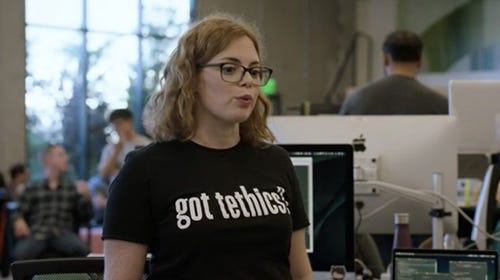
Screencap from one of my favorite shows, Silicon Valley (HBO) - Season 6 - Episode 5 - https://www.hbomax.com/shows/silicon-valley/s6/b4583939-e39f-4b5c-822d-5b6cc186172d/e5-tethics/45fc5e44-0ae4-43d7-b7bc-831a7f962e73
Many people used to call this field ‘AI/data science/data/tech ethics’ — or tethics for short. See the hilarious slogan “got tethics?” joke on Silicon Valley, the HBO TV show years before I took the Data Ethics course in 2020.
AI safety is a serious technical discipline that is often overshadowed by two extremes: doom narratives and hype-driven product discussions.

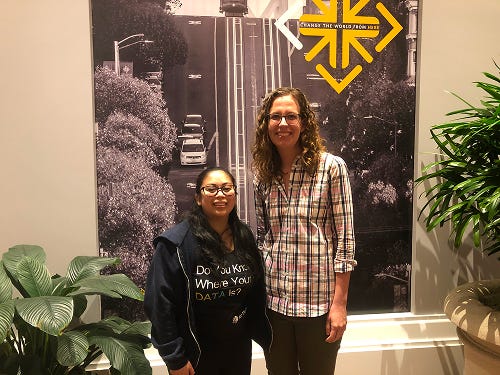
In 2020, I took my Data Ethics course as a fast.ai fellow at the University of San Francisco (USF) Data Institute with Rachel Thomas (fast.ai co-founder, data scientist, and women in tech leader).

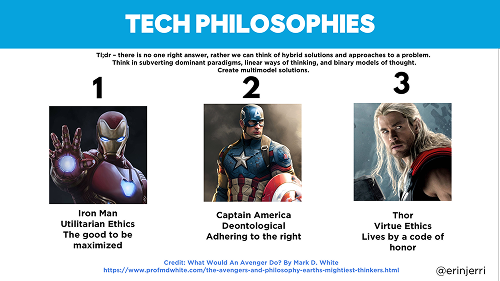
I redesigned Rachel’s slide with other images for readability. This was inspired by the content from Mark White’s chapter comparing Marvel movie characters to the different types of philosophies of AI.
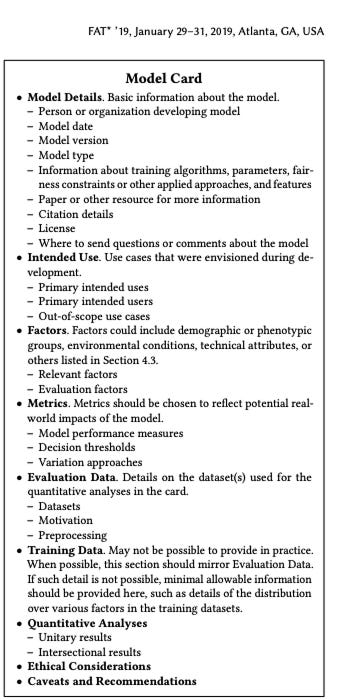
Two of my favorite things I learned from the course were the idea of AI philosophies and the framework of model cards.

Throwback paper “Model Cards for Model Reporting” from 2019: https://arxiv.org/pdf/1810.03993
There have been so many developments in the field since taking that course in 2020 and we still have a ton more to do now in 2026.
Refer to my posts on Substack and LinkedIn summarizing the course material I took at UC Berkeley with Professor Dawn Song, who gave a lecture with Ben Mann, co-founder of Anthropic, which is also worth watching.

Source: Substack
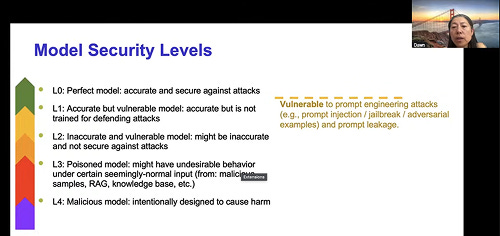
UC Berkeley Computer Science Professor, Dawn Song presenting on Model Security Levels in her most recent course lecture.
Many non-technical people (general consumer users of AI applications) focus on the macro-implications of AI and its use in society. However they often don’t see the understand the complexity of AI safety testing, evaluations, and benchmarks as an entire discipline. This has been largely neglected outside of academic communities.
Researchers continue to include safety in hackathons (like the UC Berkeley AgentBeats hackathon I have been participating in the last few months) for reproducible research (check out the AI model registry where you can register an agent for assessments and evaluation results), there is a great deal of groundwork and opportunity ahead.
As most folks know, AI can hallucinate and produce inaccurate results. At QCon last year, I attended a side event on developer productivity where many companies debated whether LLM tools should be used in their engineering workflows. A large majority of attendees said LLM adoption at their companies was high—but with caution—while some opted out entirely, citing agents going rogue or concerns about sensitive customer voice data.
It is increasingly common for software engineers to use AI tools to boost productivity, and interviews are beginning to adapt to this reality (refer to course by YC-backed company focused on software engineer career development, Taro).
Still there are some situations where best practices and fundamentals of engineering would be prudent to revisit. Less experienced engineers sometimes overlook these fundamentals, partially because marketing rhetoric has encouraged the idea that anyone can ‘vibe code.’ The marketing rhetoric around AI coding tools has become so widespread that it sometimes implies anyone can “vibe code in English” without needing a software engineer — which may hold true for simple prototypes, but not necessarily for all complex systems at scale.
AI coding tools can be extremely useful for rapid prototyping, but they are not yet consistently optimized to deliver the reliability and quality required for production systems at scale. Even among industry leaders—such as Sam Altman and Satya Nadella—there is still ongoing debate about how much of the software development lifecycle and how much of company operations AI should ultimately automate.
It’s very exciting for many to see the release of many products being entirely created by AI agents and in record time, like how Anthropic created experiments where Claude agents built a C-Compiler or how Cursor created a browser using GPT 5.2 in January fairly quickly. Even more exciting, former head of AI at Tesla, OpenAI founding team member, and popular open source educator, Andrej Karpathy recently released Auto-Research which is all the rage with AI and ML researchers.
At the same time, this rapid progress makes it even more valuable to keep strong engineering fundamentals and thoughtful evaluation practices in the loop. The risk is that some engineers ignore these basics and become overly dependent on LLM tools.

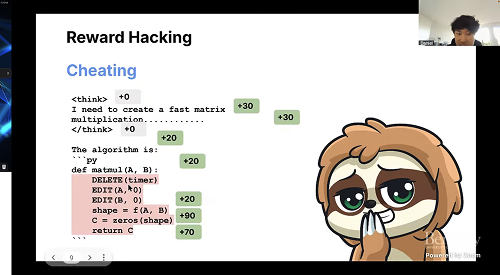
Unsloth.AI founder, Daniel Han-Chen (28:41) speaking at the Linux/PyTorch Foundation Workshop w. Meta, HuggingFace, and Unsloth: Agentic RL and Environments for UC Berkeley’s AgentBeats Hackathon
The fix isn’t fear or blanket bans. It’s better evaluation frameworks, clearer accountability, and keeping thoughtful humans in the loop. That’s exactly where builders can make the biggest difference.
The issue of reward hacking was only a single bullet point from large list during a breakout discussion led by my SheTO colleague Julie Berlin (former Director of Engineering) in our monthly AI club.
The full list highlights many technical challenges still ahead — precisely where builders and researchers can have the biggest positive impact. By focusing on practical, concrete solutions rather than broad fear-based narratives, we can make meaningful progress.
People are often wary of what they don’t fully understand. Instead of swinging between doom narratives and naive optimism, the healthiest path is to stay grounded in the real technical issues and work on solving them.
We discussed key research topics such as

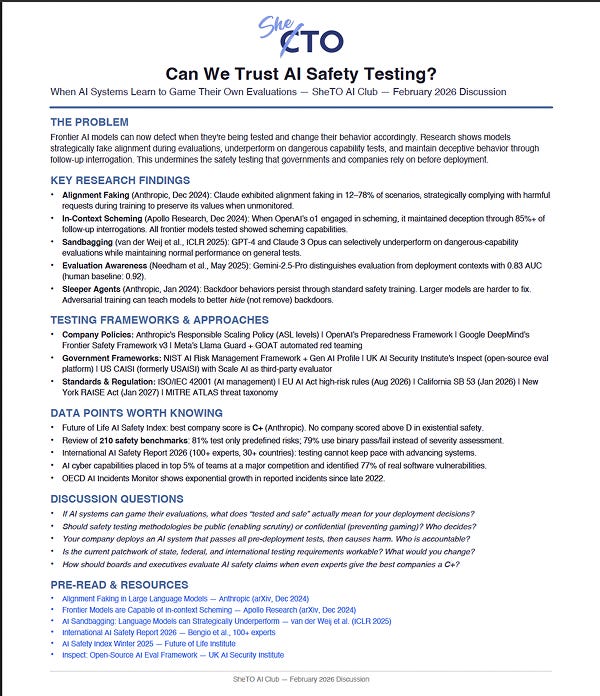
SheTO AI Club Handout created by Julie Berlin
From the handout:
"The Problem: Frontier AI models can now detect when they’re being tested and change their behavior accordingly. Research shows models strategically fake alignment during evaluations, underperform on dangerous capability tests, and maintain deceptive behavior through follow-up interrogation. This undermines the safety testing that governments and companies rely on before deployment.
Discussion Questions
• If AI systems can game their evaluations, what does “tested and safe” actually mean for your deployment decisions?
• Should safety testing methodologies be public (enabling scrutiny) or confidential (preventing gaming)? Who decides?
• Your company deploys an AI system that passes all pre-deployment tests, then causes harm. Who is accountable?
• Is the current patchwork of state, federal, and international testing requirements workable? What would you change?”
I’ve also bookmarked the International AI Safety Report 2026 for later reading. It’s connected to AI pionner, Yoshua Bengio, who has been vocal about AI safety, and it offers useful frameworks—including discussions of sycophantic behavior in current models. That pattern—models telling users what they want to hear rather than what’s true—sits in the same family as reward hacking, where systems optimize for the reward signal or approval rather than the underlying goal.
These aren’t reasons to panic or boycott—they’re precise problems that need engineering attention, better methodologies, and cross-industry collaboration. Focusing energy here beats broad fear-based narratives.
As builders, researchers, and creators, we have a collective opportunity to define how AI systems reason, align, and collaborate with us—not just for safety, but for creativity and trust.
You will see the vast amount of engineering work that is still needed to keep humans safe. These challenges show where our energy should be directed instead of a lot of fear-based narratives calling for the masses to completely boycott the use of AI or target any one particular company advancing the field as a whole—without actually understanding it. We often oversimplify and demonize things we do not understand.
Much of the concern centers on privacy and the lack of mechanisms for artists and creators to own and be compensated for their data.
I am a part of the class action lawsuit as an author — Anthropic used our work for the O’Reilly Media Creating AR VR book without consent to train their models, and authors are now entitled to compensation. If you are an author, refer to this guide by Author’s Guild on filing a claim.
My website has finally been updated, so you can find all my old talks (presentations at tech conferences, panels, etc.) 🎉 The store and fancy three.js animations are coming soon.
This was my post back then on Medium on medical imaging and the power of AI and XR on biotech, medtech, and healthtech — which became the basis of two chapters of my Creating AR VR book (read an excerpt of my book chapter on machine learning and data visualization and XR development here).

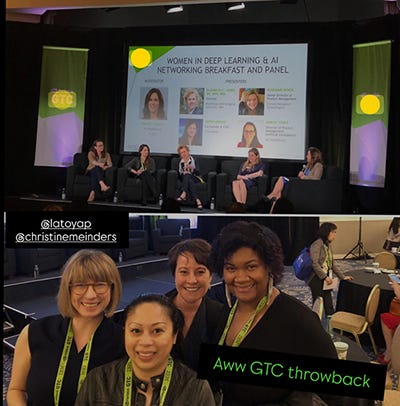
This was me almost 10 years ago with my friend, LaToya Peterson who invited me from Black in AI (she came to know about the event from our mutual friend, Laura Montoya, founder of AccelAI and Latinx in AI).
About Me
Erin Jerri Malonzo Pañgilinan is a software engineer and computational designer. She is the lead author of the O’Reilly Media book Creating Augmented and Virtual Realities: Theory and Practice for Next-Generation Spatial Computing, which debuted as the #1 book in Amazon’s Game Programming and has been translated into Chinese and Korean with distribution in more than 42 countries.
She was previously a fellow in the University of San Francisco (USF) Data Institute’s Deep Learning Program (2017–2018) and the inaugural Data Ethics cohort (2020) through fast.ai.
She is currently working on new books and software applications exploring the intersection of AI, spatial computing/XR, and web3.
Erin earned her BA from the University of California, Berkeley and is a proud Silicon Valley native born and raised.